
Scott County Crime News Sources
The most reliable recurring local outlet is Scott County News. Its Sheriff's Report archive pulls together material from the Oneida Police Department and the Scott County Sheriff's Office in one weekly, text-first package. Think of it as a running summary of agency paperwork. That makes it great context. It is useless for learning who is currently behind bars, since it is neither a live roster nor a gallery of booking photos. Two other outlets fill different gaps. The Independent Herald posts daily local news. Arrest stories there appear irregularly, not under a dedicated booking heading. WVLT's Scott County reporting works differently again. It chases selected breaking events with regional reach, usually built on an agency or federal release. Neither one functions as a continuously updated custody source for the county. For the authoritative base, use the sheriff's department page. It points to the county jail's ISOMS views. A story can hand you a name, a date, an agency, and a version of events. Verifying current custody and case status belongs to the official portal and the right court.
Scott County Outlet Guide
Official sources come first here. They are the proper record route. The outlets listed after them tell you what was published and when. One caution: never relabel a publisher's posting date as a booking date or a court outcome.
| Outlet | Coverage | Photos? | Where |
|---|---|---|---|
| Scott County Sheriff's Department | Sheriff Brian Keeton's official county law-enforcement hub with links to custody views. | No public online photo display was observed in the indexed portal output. | Sheriff page and linked ISOMS jail routes. |
| ISOMS 72-hour view | Recent intake and release activity at the Justice Center. | No photo field observed in the indexed text output. | Official county jail portal. |
| Scott County News | Combined Oneida Police and sheriff reports, generally weekly. | Text-first, no dedicated gallery located. | Sheriff's Report archive. |
| Independent Herald | Daily local reporting with irregular individual arrest stories. | Story, agency, or illustrative images can vary. | News category. |
| WVLT | Regional, event-driven reports based on agency or federal releases. | May use agency-supplied or illustrative visuals. | Selected Scott County stories. |
| BustedNewspaper | Confirmed third-party Scott County historical and comparison layer. | Its detail pages can include photos. | Unofficial and potentially stale; it never replaces ISOMS. |
BustedNewspaper stands out here. It is the only county-specific commercial publisher with confirmed Scott County pages. Its material can linger past the official 72-hour window. That helps with older items. Take the content with care, though, since the site itself warns that details may be inaccurate or out of date. No verified Scott County, Tennessee section exists on RecentlyBooked, Arrests.org, or Mugshots.zone. Mugshots.com offers only a state-level directory rather than a local detail page. So none of them serves as a workable local record route.
Scott County Sheriff's Report Pattern
The Scott County News Sheriff's Report archive is the clearest example of the county's recurring report format, blending sheriff and Oneida police material into one category.
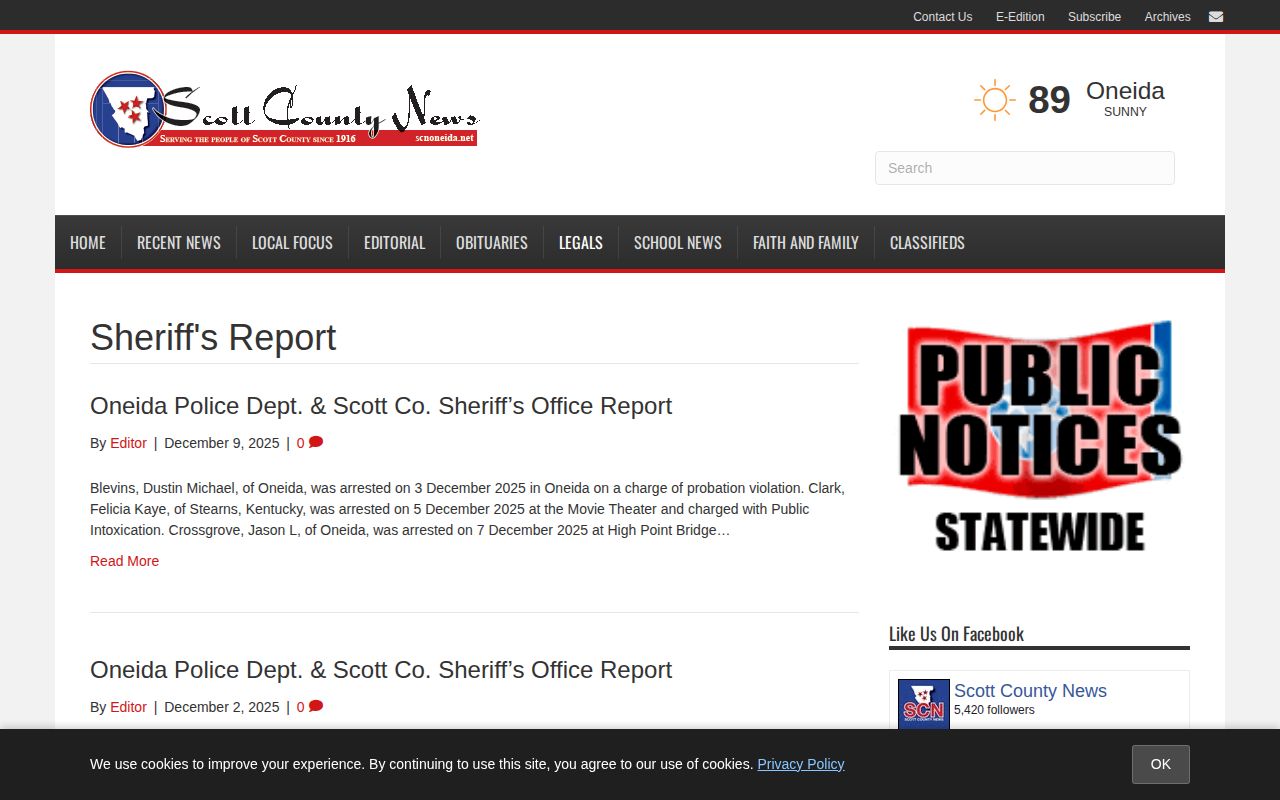
That archive helps in two ways. It can locate a dated report. It also shows which agency supplied the information behind it. It does not convert the outlet into an official roster. Treat any image on a news page cautiously, too, unless the article itself labels it a jail booking photo. The combined report is a genuine local bridge. It covers Oneida Police Department and Scott County Sheriff's Office activity side by side. When a story starts with an Oneida incident, the Oneida Busted Mugshots guide lays out the separate municipal report route and the county custody path. For current status, though, go back to the county's official portal. Do not trust an archived article.
Scott County News Photo Limits
What about photos? The indexed ISOMS roster output shows no public booking-photo field or image. The sheriff's page posts no jail-photo policy either. That is a narrow fact about the portal. It is not a claim that booking photographs never exist here or can never be requested. Tennessee's public-record laws give citizens a way to obtain existing open records, though some are restricted. The county's Public Records page names a coordinator and links a request form. Want an older booking record or a photo that never appeared online? Ask for the existing record with focused details: the date, the agency, and a booking or case number if you have one. You can also ask the custodian to explain any withholding basis and whether a redacted copy is an option. Newsrooms, meanwhile, make their own image choices. A story might carry a supplied agency photo, a file photo, a licensed image, or an illustration. None of that reflects county jail policy. Tennessee Code sections 10-7-503 and 10-7-504 govern public access and exceptions. They create no promise of a current online mugshot gallery. The source, the date, and the type of record should stay visible no matter where an image turns up.
From Scott County Story to Record
A story is a first clue. It points you toward a record, not the whole truth of one. Follow the agency that owns each fact. That order prevents two common mistakes. One is reading an article's publication date as the jail's booking date. The other is treating a booking charge as the final word on a case.
- Record the story's publication date, the agency named, and the event or booking date only as the story reports it.
- Use the official 72-hour intake and release view for a recent custody event, then the current database or name search if needed.
- Read the ISOMS fields literally: intake indicates local entry, release indicates the end of that booking's local custody status, and the agency, charge, and bond fields describe the booking record.
- Use the county public-record route for a focused copy request if the needed existing record is not exposed online.
- Check the originating court for a docket, disposition, or judgment. The Circuit Court page identifies Clerk Donnie Phillips and lists (423) 663-2440 for Circuit, Criminal, and General Sessions records.
Scott County Record Dates
Three different dates tend to orbit a single crime story. Keeping them apart matters most when an article stays online long after someone has left the Justice Center, or when a court case has since changed shape.
| Date label | What it means | Best source |
|---|---|---|
| Publication date | When the news organization posted or updated its report. | The outlet's article page. |
| Intake or release date | When ISOMS recorded a local jail entry or the end of that booking's local custody. | The official ISOMS portal. |
| Page check date | When a reader or publisher reviewed a source. | The reviewer's dated note, not the event record. |
A current jail database holds more than fresh arrests. Its vocabulary is broader than you might expect. Entries can show a hold, a probation-related item, a serving-time status, or custody held for another agency. Someone released from Scott County custody drops off the current roster. That can happen while a court case is still rolling on. A person sentenced to state custody moves into a separate system, the TDOC FOIL, which has nothing to do with the county's current booking view.
Scott County Court Follow-Through
Tennessee offers no single statewide search that pulls every Scott County lower-court outcome. The state's Public Case History tool leans appellate, so it will not trace a case from booking to final judgment. Start instead with the Circuit Court Clerk. Ask which court holds the originating file, because that office controls the record you need.
Cases can end many ways. Dismissal, diversion, a reduced charge, a plea, nolle prosequi, or a judgment still pending all appear in local dockets. A jail intake report only documents custody. The disposition comes later, from a separate court document. The Scott County booking-record guide covers the current roster, release information, and records-request routes in more depth.
News stories age, even accurate ones. A charge gets amended, a case is dropped, or a judgment lands months after the ink dries. Whatever happens next belongs to the source that decided it, not to the original article. Treat local coverage as dated reporting and keep the chain of sources intact rather than letting one story stand as a person's permanent status.
Keep official sources first. A publisher's archive may be easier to browse, and commercial sites can help you spot a historical reference, but neither replaces a live ISOMS result or the court's own file. That order respects both the person named in the story and the real limits of every source.